
Quick Answer
LeiaPix became Immersity AI in May 2024. Its depth effects need a different review from an ordinary still image: check which objects appear nearer, where edges stretch and whether the intended viewer supports the chosen output. A convincing depth effect is not evidence of measured dimensions or a newly photographed viewpoint.
Follow the product’s identity past the old list
The historical Elegant Themes AI website roundup included LeiaPix among unrelated tools. That collection has since changed. Its old rankings, free-access statements and credit allowances are not a current purchasing guide.
Leia’s May 22, 2024 announcement identifies LeiaPix as the predecessor to Immersity AI and describes depth and motion conversion. Keep that dated product transition separate from any current feature, account or export entitlement.
Review relative depth rather than assuming a measurement
The current vendor FAQ describes grayscale depth maps with lighter areas nearer and darker areas farther away. It also specifies disparity rather than absolute distance for imported depth maps. That is a reason to inspect the intended visual ordering, not to treat the map as a survey of physical dimensions.
For a marketing visual, ask what the source picture actually supports. An inferred separation can create motion around a still image, but newly revealed-looking areas do not establish that a camera captured those areas.
Inspect one foreground edge through the motion
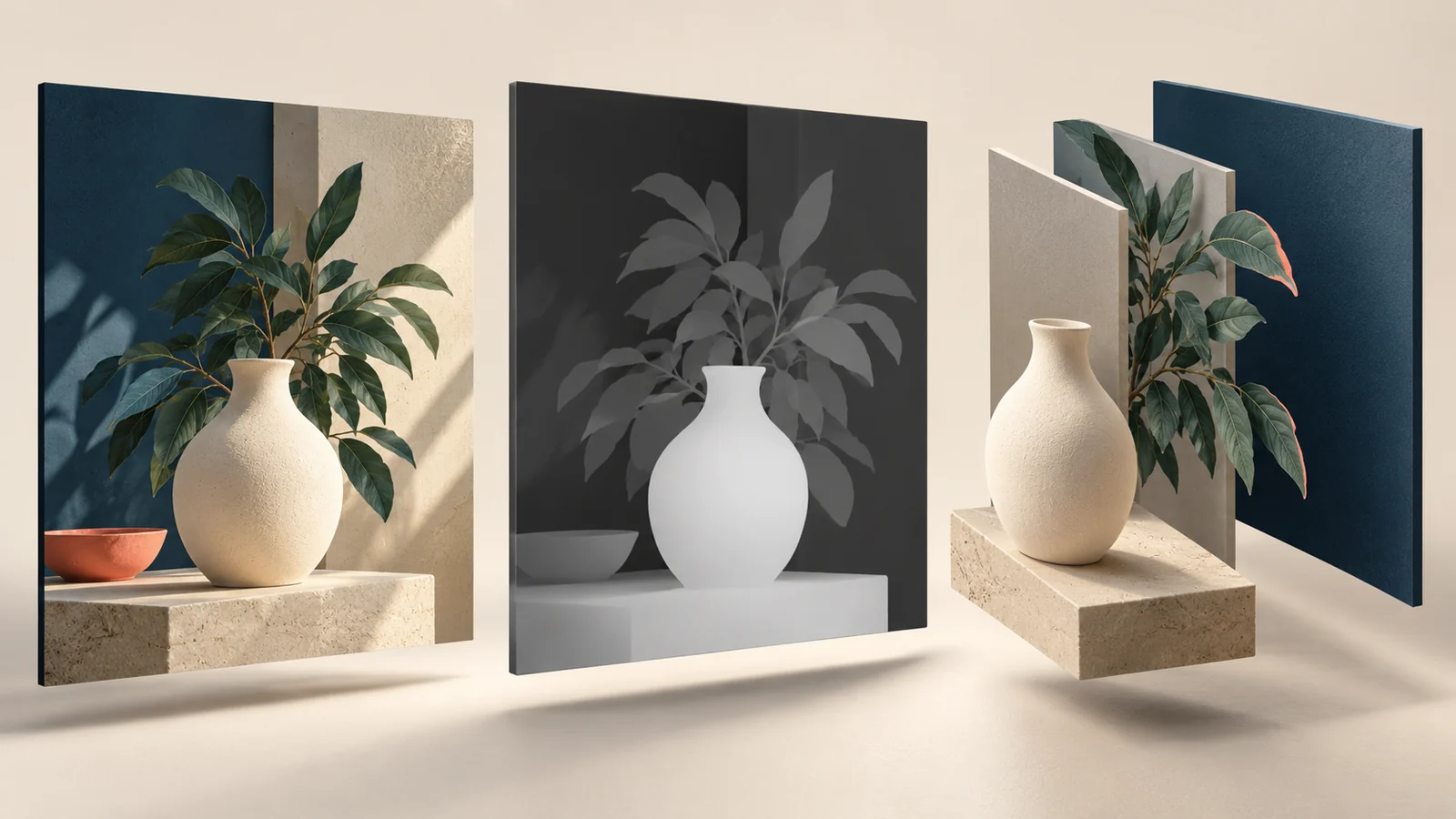
Consider an invented still life with a vase in front of a leafy plant and a wall. This is a proposed review exercise, not a conversion we performed:
- Intended ordering
- The vase should remain in front of the plant, and the wall should remain behind both. Compare the depth interpretation with that intended relationship before judging the motion’s attractiveness.
- Edge under review
- Follow the outline of a leaf where it meets the wall throughout the proposed motion. Look for stretching, a moving halo or background areas appearing attached to the leaf.
- Adjustment tradeoff
- The vendor describes dilation as a way to reduce edge stretching, but warns that excessive dilation can bring background objects forward. If that happens, record the new ordering problem instead of treating a smoother edge as an automatic pass.
- Release choice
- Compare a restrained effect with the approved still image. Keep the still available when the motion distracts from the subject or the edge problem remains unresolved.
- Evidence boundary
- Record the source image, selected output and reviewed playback environment. Do not describe the result as a measured 3D model or an actual new camera view.
Check the destination format
The FAQ distinguishes motion viewable on ordinary 2D displays from immersive stereo outputs that need suitable viewing equipment. Review the actual intended device and player rather than approving a file solely because it exported.
Choose a fallback and presentation that suit the page’s purpose. No image was uploaded, converted or tested in an account for this article. The cover is a conceptual illustration of the review process.
The AI image evidence guide explains how to describe generated visuals honestly. The AI website platform guide concerns the system behind a product label.
Key Takeaways
- Use the current product identity, with the rebrand date preserved.
- Inspect relative depth and foreground edges.
- Review dilation’s tradeoff rather than assuming more is better.
- Match the output to the viewer and keep evidence claims limited.
Frequently Asked Questions
Is LeiaPix still the current name?
The vendor announced its transition to Immersity AI on May 22, 2024. Verify the current product and account offering before planning work.
Does a depth map provide real-world measurements?
Do not assume that. The vendor’s imported-map guidance specifies disparity, not absolute distance. An attractive effect does not establish measured dimensions.
Will more dilation always improve the result?
No. It can reduce edge stretching while also bringing background material forward. Review both the edge and the intended depth order.