
Quick Answer
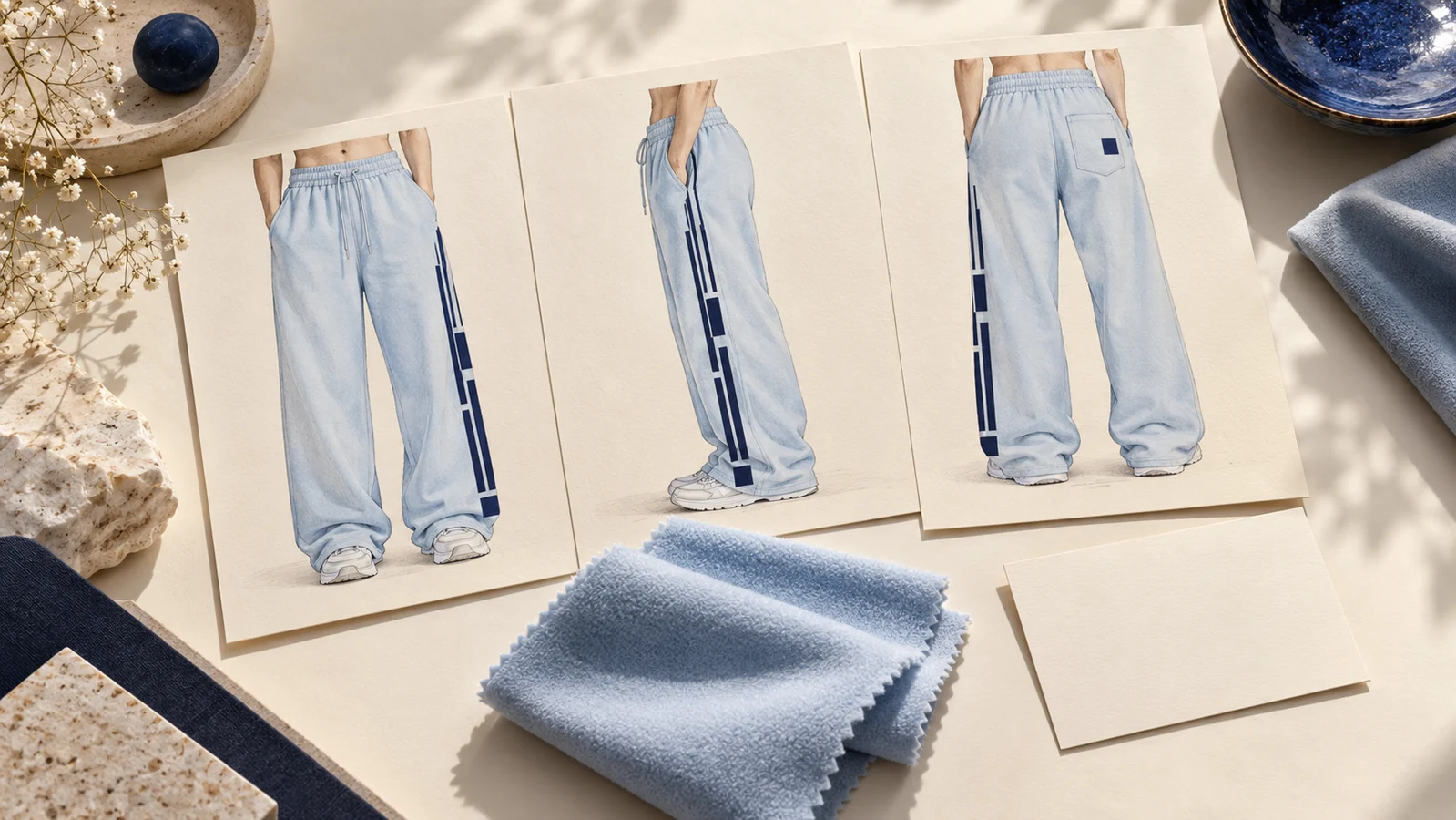
Review sweatpants artwork across the required front, back and side views, using the wearer’s left and right to identify placement. Check how lettering relates to pockets, waistbands and folds. A convincing mockup can communicate a design, but it cannot verify the manufactured garment’s fit, stretch, print process or color.
Start with the actual garment form
The December 25, 2023 roundup includes different jogger, sweatpants and leggings presentations. Those forms are not interchangeable. Match the proposed garment’s silhouette, waistband, pockets and leg shape before evaluating its graphics.
A fitted leggings image may distort the intended appearance of a loose fleece design. Likewise, a view that hides the back pocket cannot answer a question about artwork near that pocket. List the views needed for the decision instead of choosing only the most dramatic scene.
Define left and right from the wearer
Label the intended placement as wearer-left or wearer-right. “Left side” by itself can mean the viewer’s left in a front-facing preview and produce the wrong placement. Keep the approved artwork version with that description.
Identify which editable source supplies each view. In a Photoshop template that uses Smart Objects, Adobe’s editing guidance explains saving the source to update linked instances. Inspect which instances are actually linked; do not assume every view shares the same artwork or should share it.
Trace one illustrative leg design
Suppose a hypothetical design puts a vertical wordmark on the wearer’s left outer leg and a separate small mark near a back pocket. This proposed review record makes the apparel checks concrete:
- Front view
- Identify the wearer’s left leg, then compare the wordmark’s orientation and distance from the pocket opening with the approved placement plan.
- Side view
- Inspect whether the lettering remains on the intended outer leg and whether drape conceals important letters. Do not rotate or mirror the source merely to make the scene look balanced.
- Back view
- Check the separate pocket mark, waistband and leg graphic continuity. Flag a view that substitutes the front graphic for the approved back treatment.
- Open decision
- If a required placement is hidden by a fold, request a suitable additional view or physical review. Keep that question unresolved rather than inferring the missing detail.
This is an invented review exercise, not a mockup we edited or a produced clothing sample.
Keep physical verification separate
The garment supplier must confirm dimensions, production placement, materials and the appropriate physical proof. A simulated fabric texture does not establish the actual fabric’s stretch or how a printed design behaves when worn.
Keep concept previews distinguishable from photographs of actual merchandise. Before a storefront uses an image, have the responsible owner verify that it represents what will be supplied and that the image and artwork permissions cover the intended use.
Our mockup file and permission guide covers the underlying asset review. For an online presentation, our website redesign service can help plan the product-image requirements and the handoff to whoever maintains them.
Key Takeaways
- Match the garment form and required views.
- Use wearer-left and wearer-right for unambiguous placement.
- Check pockets, waistbands, folds and continuity.
- Keep the mockup separate from physical production proof.
Frequently Asked Questions
Can I use a leggings scene to approve loose sweatpants?
Only if it answers the specific presentation question accurately. The different silhouette and drape may make it unsuitable for approving the intended garment.
Does a mirrored view preserve the placement?
It can reverse lettering or move a design to the wrong wearer side. Compare the view with the approved placement rather than relying on symmetry.
Does the mockup prove the final print will stretch correctly?
No. Have the supplier verify the actual material, decoration process and appropriate physical sample.